
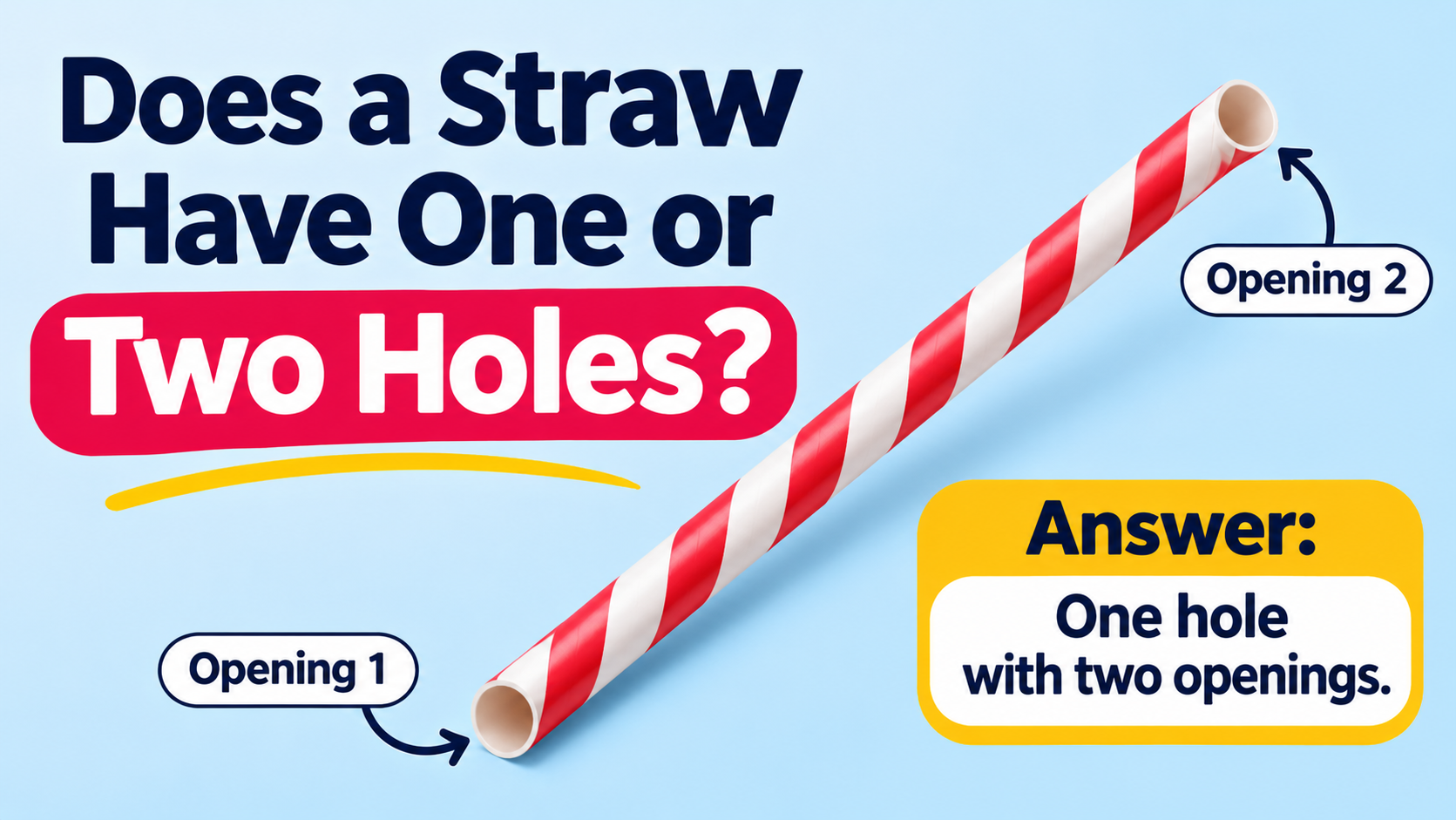
Have you ever wondered, does a straw have one or two holes? This simple question has sparked countless debates on social media, in classrooms, and among friends. Some people count the openings at both ends, while others argue that a straw contains one continuous tunnel. Surprisingly, mathematics offers a clear explanation, although the answer depends on how we define a hole.
Does a Straw Have One or Two Holes?
According to topology, a standard drinking straw has one hole with two openings.
A straw contains a continuous passage connecting its two ends. Although you can see an opening at either end, both lead into the same hollow space.
This distinction explains why mathematicians generally favor the one-hole answer.
However, people who count two openings are describing a different feature of the straw.
Why Do Some People Say a Straw Has Two Holes?
The two-hole argument comes from everyday observation.
When you examine a drinking straw, you can clearly see two circular openings. One end enters your drink, while the other reaches your mouth.
Because people commonly describe openings as holes, counting two seems reasonable.
The disagreement begins when we use the word “hole” to describe both an entrance and an entire passage.
In ordinary conversation, either interpretation may seem understandable.
What Does Mathematics Say About Straw Holes?
The mathematical field of topology studies properties of shapes that remain unchanged when objects are stretched, bent, or compressed without cutting or joining them.
A straw can be imagined as a hollow cylinder.
If you gradually shorten this cylinder without closing its central passage, its shape approaches a flat ring.
That ring has one central hole.
This mathematical relationship supports the argument that a straw has one hole rather than two.
Is a Straw Like a Donut?
A straw and a donut both provide familiar examples of continuous passages.
However, their surfaces are not topologically identical. A straw has two circular boundaries, while a donut-shaped surface has none.
A more accurate comparison is between a straw and a flat ring, since both have one independent circular loop.
This distinction helps explain the mathematics without oversimplifying it.
Can a Straw Have Zero Holes?
Some people argue that a straw has no holes because its hollow interior is simply part of its original structure.
This interpretation uses a different meaning of the word “hole,” such as damage created by puncturing a solid object.
However, under the common topological interpretation, the straw’s continuous central passage counts as one hole.
Why Is This Question So Popular?
The debate is entertaining because both sides can provide explanations that sound convincing.
It also encourages people to question familiar objects and think about how language influences reasoning.
A simple drinking straw becomes an interesting example of mathematics, geometry, and everyday logic.
Final Answer: One Hole or Two?
So, does a straw have one or two holes? The mathematical answer is one hole with two openings.
The two-hole argument counts the visible entrances, while topology considers the connected structure.
Ultimately, the debate demonstrates how an ordinary household object can inspire surprisingly interesting scientific discussions.
